Vara Aagamana
Arrival & Honoring of the Groom
Nihal and his family arrive amidst the traditional South Indian music of Nadaswaram and are received by Prithvi's parents and family at the entrance to the wedding venue. Nihal is warmly welcomed with Aarti; he and his family are then escorted to the Mandapam by Prithvi's family. Prithvi's father honors Nihal by washing his feet and worshipping him as the embodiment of the Lord - in Hindu tradition, the groom is considered a manifestation of God himself.
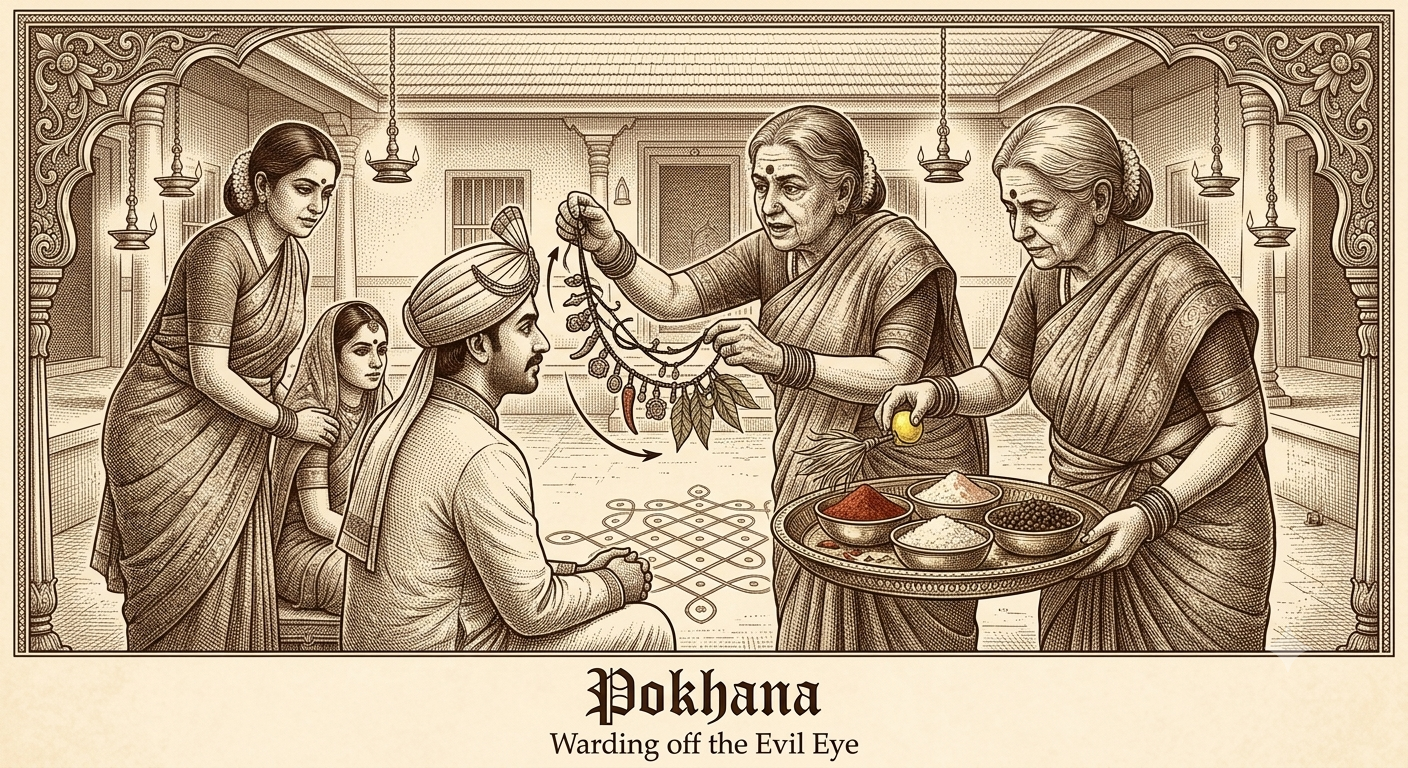
Pokhana
Warding off the Evil Eye
During the Ponkhana ceremony, the bride's mother waves four specific symbolic wooden items in all four directions (North, South, East, and West). This ritual is performed to ward off negative energies coming from any direction and to bring comprehensive good luck, wealth, and prosperity to the groom. The traditional Ponkhana set represents old-world, domestic Indian kitchen tools and construction elements. By waving or tossing them in all four directions, the mother-in-law tests the groom's patience and blesses his domestic life:
1) Sambelu (Miniature Pestle): A long, smooth wooden cylinder. It represents a pounding pestle and symbolizes hard work, strength, and stamina.
2) Ravlo (Miniature Churner / Madhni): A textured wooden stick used to churn buttermilk. It symbolizes the couple's ability to smoothly blend their two families and stay resilient through life's changes.
3) Taanklo (Miniature Spindle / Goad): A thin wooden rod. Traditionally used to herd livestock, it symbolizes focus, control, and keeping the family moving in the right direction.
4) Dandiyo (Pounder / Stick): A solid wooden stick. It represents domestic utility, structure, and providing stability for the new household.
The set includes a fifth item called the Samput (two small clay bowls tied face-to-face with cotton thread). This sits at the center to protect the couple's inner bond. Immediately after clearing the four directions, the groom steps forward and forcefully stomps on the Samput. Crushing it means he can conquer any obstacle coming from any corner of the world.
Ganesh Pooja & Gauri Pooja
The First Prayer
The ceremony formally begins with a pooja to Lord Ganesha, God of Wisdom, Learning, and the Remover of all Obstacles. It is customary in both the South Indian and Gujarati traditions to seek Ganesha's blessings before any auspicious event. Simultaneously, in private, Prithvi offers prayers to Goddess Gowri, seeking her blessings for a joyful married life.
Kashi Yatra
The Groom's Mock Pilgrimage
Nihal playfully pretends to renounce the world and set off on a pilgrimage to Kashi to become a monk - complete with staff, umbrella, and bundle. Prithvi's father lovingly intercepts him and persuades him that the life of a householder is equally sacred and fulfilling. This lighthearted ritual symbolises Nihal's wholehearted willingness to embrace married life.
Baaraat
Ceremonial Welcome of the Groom
Prithvi's father offers Nihal a sacred mixture of curd, ghee, and honey - all considered auspicious and health-giving - along with the symbolic gift of a cow representing Kamadhenu, the divine wish-fulfilling cow. In accepting Madhuparkam, Nihal formally agrees to return from his mock pilgrimage and embrace married life, while Prithvi's family joyfully signifies their consent to give their daughter's hand in marriage.
Kanya Aagamana
Arrival of the Bride
Prithvi arrives at the mandapam accompanied by her parents, amidst the chanting of Vedic hymns.
Maalai Matral
Exchange of Garlands
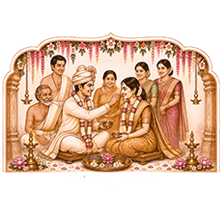
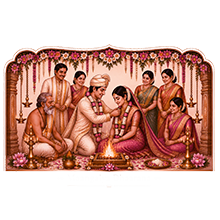
Prithvi and Nihal exchange floral garlands three times in the presence of their families. The flowers symbolise happiness and beauty. The thread that binds them signifies that like the thread holding the flowers through all seasons, Prithvi and Nihal will hold each other through every joy and trial of life. The maternal uncles of both families join in playfully, each trying to help their ward garland first, making this one of the most joyful and laughter-filled moments of the ceremony.
Oonjal
The Swing Ceremony
Prithvi and Nihal are seated together on a beautifully decorated swing and rocked gently to and fro. The oscillating motion of the swing carries a message - that Prithvi and Nihal will support each other through every high and low of married life. Women from both families sing traditional oonjal songs and offer milk and bananas as blessings for the couple.
Pachchai Pidi Suththal
Warding off the Evil Eye
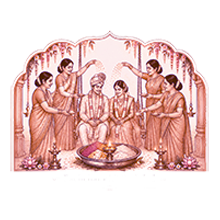
Five married women (sumangalis) perform this protective ritual during the oonjal. Cooked rice in three colours - red, yellow, and white - along with milk and Aarti, is placed in a large brass plate. The women wave handfuls of rice in a wide arc around Prithvi and Nihal before casting it down in all four directions to ward off the evil eye and negative energies.
Antarapattu
The Sacred Curtain
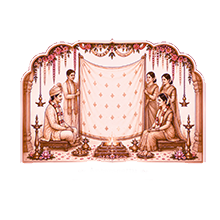
The Antarapattu, a beautifully decorated curtain, is placed between Prithvi and Nihal, symbolising their existence as two separate individuals before the sacred union that is about to take place. The curtain symbolises the world that has kept them apart; its removal marks the moment they become one.
Jeerighe Bella
The Inseparable Mixture
At the sumuhurtham, the auspicious moment, the Antarapattu is lowered and Prithvi and Nihal share their first glance at each other as bride and groom. They apply a paste of cumin seeds (bitter) and jaggery (sweet) on each other's heads, symbolising their commitment to stand by each other through both the bitter and sweet moments of life.
Kankana Bandhana
Tying of the Sacred Thread
Sacred threads charged with Vedic mantras by the priest and elders are tied around the wrists of Prithvi and Nihal. As the mantras permeate the thread, Prithvi and Nihal are now considered the living embodiments of Goddess Lakshmi and Lord Narayana. The Kankana serves as a protective vow, sealing them as sacred participants and shielding them from negative energies as the main wedding rituals begin.
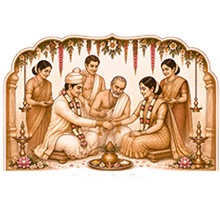
In the most emotionally sacred moment of the wedding, Prithvi's parents place her right hand into Nihal's hand with love and prayers. They seek a solemn pledge from Nihal & Prithvi to cherish and care for each other in the pursuit of the four goals of human life — Dharma (righteousness), Artha (prosperity), Kaama (love), and Moksha (spiritual liberation). Sacred water is poured over a coconut held by the couple as Vedic hymns are chanted.
Maangalya Dhaarana
The Muhurtham
This is the most sacred moment of the wedding. The Mangalyam, a gold pendant representing Goddess Mahalakshmi, is first taken around the Mandapam to be blessed by all the elders of both families. At the precise muhurtham, Nihal ties the Mangalsutra around Prithvi's neck with three knots representing the physical, mental, and spiritual strength of their union for a hundred years. He then applies sindhoor (vermillion) on her forehead as a symbol of their marriage. Nadaswaram plays the Getti Melam at full volume at the exact moment of tying. Friends and relatives shower the couple with flower petals and akshata.
Hasta Milap
Joining of Hands
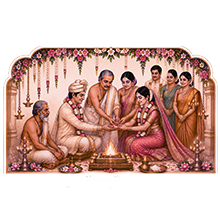
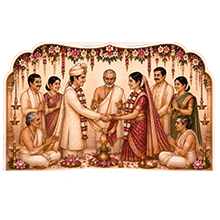
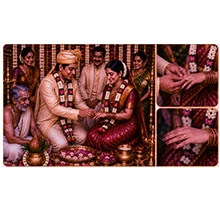
Hasta Milap, meaning the 'joining of hands', is one of the most sacred moments in the Gujarati wedding tradition. Prithvi's father places her right hand into Nihal's right hand, formally uniting them before God, family, and the sacred fire. Priest chants Vedic mantras as both families bear witness to this bond of trust and love, signifying Nihal and Prithvi's solemn commitment to protect, honour, and cherish each other through all of life's seasons.
Paani Grahanam
Holding Hands
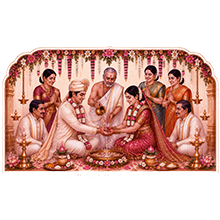
Nihal takes Prithvi's hand as her brother pours water over their joined hands, symbolizing the coming together of both families. Prithvi and Nihal together promise to lead an equitable, prosperous, and virtuous life — walking side by side as equal companions through all of life's seasons.
Cheda/ Chedi & Ghat Bandhan
Tying the Sacred Knot
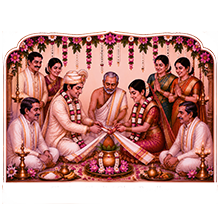
In this Gujarati ritual, Prithvi's dupatta and Nihal's shawl are tied together by the priest, symbolising their inseparable bond as husband and wife. The knot represents the intertwining of two souls, two families, and two destinies into one. This sacred knot remains tied throughout the final rituals of the ceremony, a visible emblem of Prithvi and Nihal's unity and their enduring promise of togetherness.
Agni Prathishtapana
Invoking the Sacred Fire
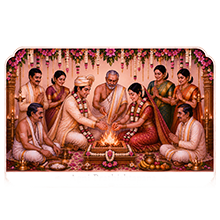
The priest kindles the sacred fire, Agni, using specific mango wood and Vedic hymns. Agni, the God of Fire and symbol of eternal light, power, and purity, is invoked as the Saakshi, the divine witness, to the marriage. All vows that Prithvi and Nihal make from this moment are made in the presence of Agni and are thereby eternally sanctified.
Akshata Dharane
Showering of Turmeric Rice
Prithvi and Nihal take turns pouring turmeric-coated akshata on each other's heads in a joyful and playful ritual. Rice is considered highly auspicious in the Kannada and Tamil traditions, symbolising prosperity and abundance. This soon becomes a lighthearted competition, bringing laughter and delight to all assembled.
Vivaha Homam
The Sacred Fire Rituals
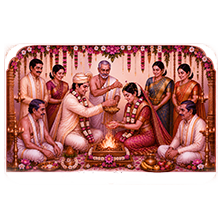
Prithvi and Nihal invoke Agni and offer ghee, sacrificial wood, and puffed grain into the sacred fire. Prithvi pours puffed grain given to her by her brother into the fire, praying for a long and joyous life together. The couple circles the sacred fire, pausing at the Ammi, a grinding stone, where Prithvi places her right foot, symbolising that she will remain as steady and unwavering as a stone in her commitment to Nihal and their home.
Sapthapadi & Metti
The Seven Steps
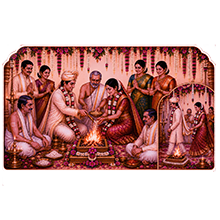
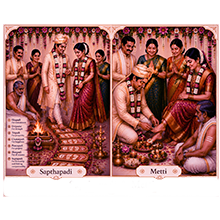
Saptapadi, the seven steps, is the most pivotal and legally binding ritual of the Hindu wedding. Nihal leads Prithvi around the sacred fire seven times. With each step, they make a solemn promise: (1) to honour and nourish each other (2) to pursue strength of mind, body, and spirit (3) to pursue prosperity (4) to pursue happiness through love and mutual understanding (5) to care for all living things and their children (6) to honour the integrity of both families (7) to remain loyal companions for life. Silver rings (Metti) are then placed on Prithvi's toes.
Arundhati Darshanam & Ammi Midithu
The Auspicious Sight of Arundhati
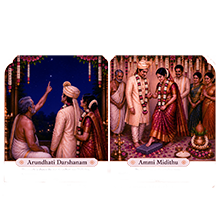
Prithvi and Nihal are led outside to observe the stars Arundhati and Vasistha, which travel through the cosmos revolving around each other, with neither being the dominant force. This star-gazing ritual invokes the blessing of a marriage of equals, grounded in mutual respect and lifelong companionship.
Akhand Sowbhagyavathi
Blessings of the Married Women
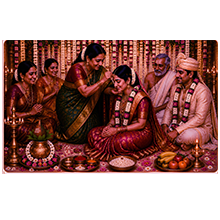
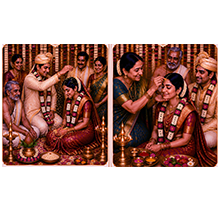
Seven married women from both families gather around Prithvi and one by one whisper the words 'Akhanda Saubhagyavati Bhava' — meaning 'be fortunate forever and have a happy life with your husband' — into her right ear. This is the most intimate and tender moment of the entire ceremony: from woman to woman, generation to generation, wisdom and love are passed on to Prithvi as she steps into her new life.
Akshata Aropanam & Deergha Saumangalvati
Showering of Sacred Rice & Blessings
Prithvi and Nihal sit facing each other and pour handfuls of akshata on each other's heads, reciting mantras. Priest chants the Deergha Saumangalvati mantra — 'May you be blessed with an unbroken, long, and auspicious life as a married woman.' Elders, family, and guests then come forward one by one to sprinkle akshata on the couple, each conveying their personal blessings.
Ungura Sambhrama
The Rings Game
Two rings — one gold, one silver — are dropped into a pot of water. Prithvi and Nihal plunge their right arms in to search for the gold ring. It is a best-of-three series — whoever finds the gold ring twice is declared the winner and said to have the 'upper hand' in the marriage! This tradition brings great laughter and joy to all assembled.
Aarati
Sacred Blessing with Light
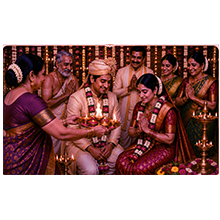
The women of both families perform Aarati, circling the flame around Prithvi and Nihal to remove all negative energies and wish the newly wed couple a life of prosperity and happiness. Prithvi and Nihal then perform Namaskara, bowing before the sacred fire, the gods, and all elders — seeking their blessings as they begin their new life together.
Aashirvaadam
Blessings from Elders
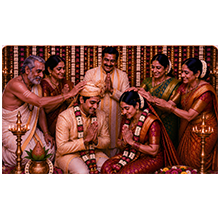
The grandmothers and elders of both families sprinkle akshata on the heads of Prithvi and Nihal, blessing them with a long life filled with joy, comfort, and wealth. Priest chants selected verses from the Vedas for universal peace and happiness. Family and friends shower the couple with rice and flowers.